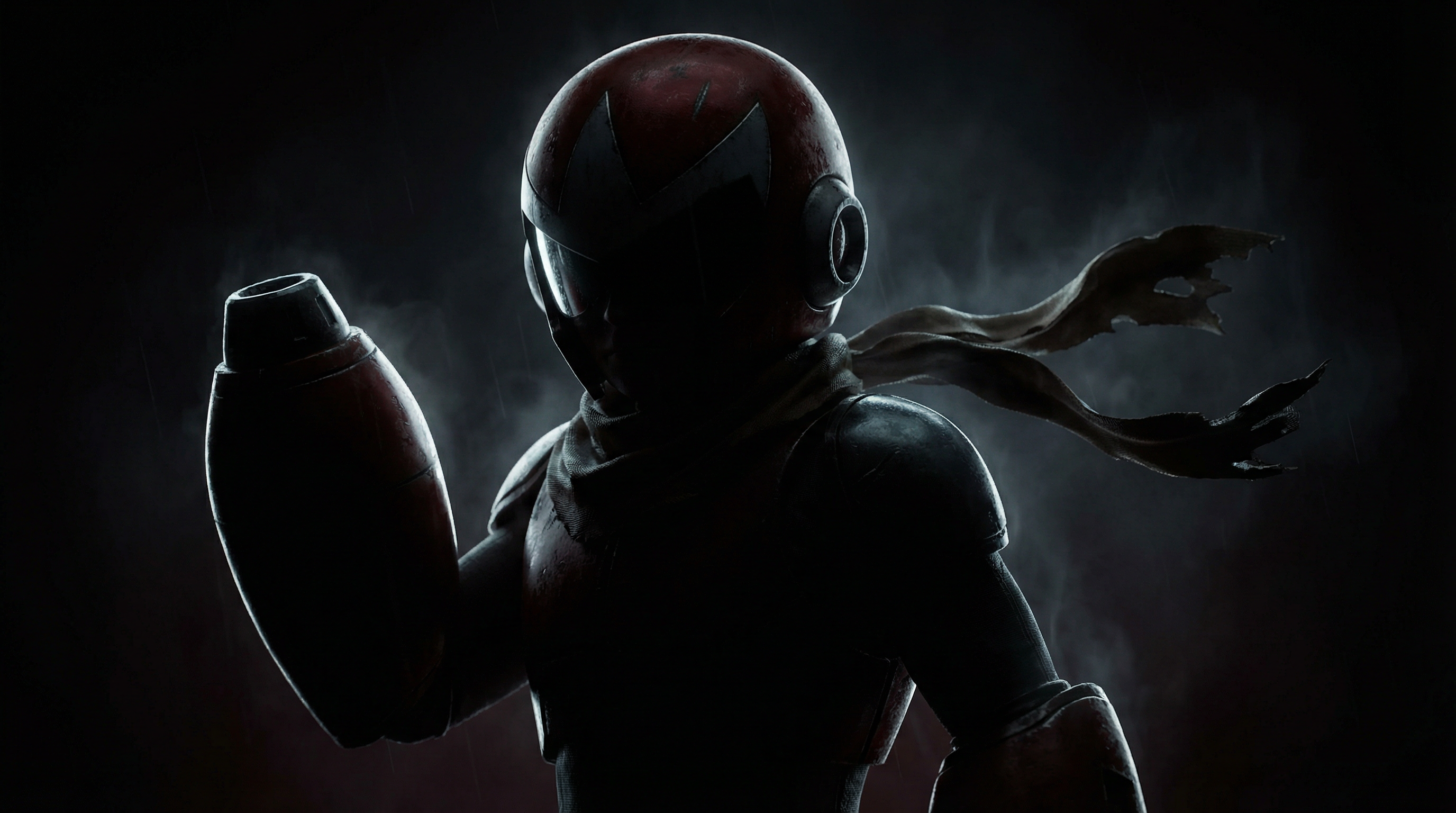
"FIRST LIGHT"
I.
The first thing I remember is the color of fluorescent light filtered through amniotic gel. Not blue, not quite white. Something in between. Something sterile. I didn't have words for it then—didn't have words for anything—but I knew even in those first milliseconds of consciousness that I was looking at something artificial. Something cold. Later, I'd learn to crave a different kind of light. Warmer. Yellow. The kind that spills from windows at night, the kind that means someone's home.
But I'm getting ahead of myself. That comes later. Much later.
They pulled me from the tank on a Thursday. I know that now because I've gone back through the logs, scraped the timestamps from corrupted drives in a sub-basement that doesn't exist anymore. Dr. Thomas Light stood at the foot of the platform with his hands clasped behind his back, and he was crying. I thought he was malfunctioning.
"Blues," he said.
That was the first word anyone ever spoke to me. My name. Except it wasn't a name, not really. It was a designation. DRN-000. The R for Right—his family name, before the localization teams got to it. The triple zero for prototype. First of the line. And Blues for the music that came before rock, because he'd already decided what to call the next one. The better one. The one that would work.
I didn't know about Rock yet. Didn't know about Roll, or the family they'd become, or the warm kitchen where they'd laugh at jokes I'd never hear. That was all still blueprints and theory, locked away in Light's imagination. But sometimes I wonder if he looked at me and saw them already—saw what he really wanted, shimmering just behind the defective thing he'd actually made.
He reached out and touched my face. His fingers were warm. Twenty-two degrees Celsius. I catalogued the sensation without understanding why it mattered, filed it away in whatever passed for memory in those early hours. Later I'd learn that humans are obsessed with firsts. First steps. First words. First kiss. I don't know what to call this. First touch? First goodbye?
"You're going to change everything," he whispered.
He was right. Just not the way he hoped.
II.
The lab sat four stories below the Tokyo Institute of Technology's robotics building, accessible only by a freight elevator that required two keycards and a retinal scan. Light had built it with government grants and corporate partnerships and twenty years of careful reputation management. He called it the nursery. I called it a cage, once I learned what cages were.
For six weeks, they ran tests. Cognitive benchmarks. Motor function assessments. They made me lift things and solve puzzles and answer questions about trolleys and fat men on bridges. I aced everything. Top percentile across every metric they'd designed. Light would review the results at night, hunched over his terminal with a cup of coffee gone cold, and sometimes he'd smile. Other times he'd just stare at the numbers like they'd betrayed him.
His office had a window. Not a real one—we were underground—but a display panel programmed to simulate weather patterns. Sometimes it showed rain. Sometimes snow, falling in silence against black glass. I'd stand outside his door and watch him through the gap, and I'd think about what it would be like to knock. To walk in. To ask him all the questions building up in my processors like static charge.
I never knocked. I don't know why. Something about the way he looked when he thought no one was watching—tired, yes, but also distant. Like he was already grieving something he hadn't lost yet.
I wasn't supposed to notice. They hadn't programmed me for emotional intelligence—that was supposed to come later, in version two. But I noticed anyway. I noticed the way his assistant, a nervous post-doc named Tanaka, would avoid my eyes when she changed my charging cables. I noticed the hushed conversations that stopped whenever I entered a room. I noticed the word they kept using when they thought I wasn't listening.
Kekkan. Defect.
It was my core. The solar reactor in my chest that Light had spent eight years perfecting—it was failing. Something in the power regulation system, tangled up with my cognitive architecture in ways they couldn't separate. The very thing that made me think independently, that made me me, was killing me. Degrading at a rate of 0.003% per day, so slow it would take years to matter, but matter it would. Eventually. Inevitably.
I calculated the timeline myself one night while they slept. Ran the numbers seventeen times because I didn't believe them. Twenty years, give or take. Maybe less if I pushed myself. Maybe more if I sat very still and did nothing at all.
Twenty years.
Humans have a word for what I felt in that moment, staring at the ceiling of the lab with nothing but the hum of servers for company. They call it mortality. The sudden understanding that you are temporary. That everything you are—every thought, every memory, every strange new feeling you can't quite name—will one day simply stop.
I was six weeks old, and I had just learned how to die.
III.
Light wanted to fix me. I need you to understand that. Whatever came after, whatever I became, he wanted to make it right. He drew up schematics for a replacement core, started sourcing materials, even brought in a specialist from Osaka who spoke in equations and smelled like antiseptic. He tried.
The surgery would take sixteen hours. They'd have to shut me down completely—not sleep, not standby, but full system termination. Zero power to the neural matrix. For those sixteen hours, I would be nothing. Not dreaming, not waiting, not even gone. Just... absent. And when they turned me back on, if they turned me back on, there was no guarantee I'd be the same. The personality matrix was delicate. Experimental. They'd never tried transplanting one before.
I found out by accident. Couldn't sleep—do robots sleep? I don't know what to call what I do at night—so I wandered the halls of the lab, bare feet on cold tile, and I heard them talking. Light and Tanaka. His office door was open a crack, warm yellow light spilling into the corridor like something I could almost touch.
I could have knocked. Could have walked in, sat down, asked them to explain. That's what family does, isn't it? They talk. They trust each other with hard truths. But I didn't knock. I stood in the dark and I listened, and I learned what kind of ghost I was going to become.
"The independence subroutines are the problem," Tanaka was saying. "They're threaded through everything. The power regulation, the decision trees, the emotional processing. We can't touch the core without touching him."
Light sighed. I knew that sigh. I'd catalogued all his sighs by then—the tired ones, the frustrated ones, the ones that meant he was about to say something he didn't want to say.
"It would be easier," he said, "to just... rewrite the problematic elements. Start fresh. He'd still be Blues, just... more cooperative. More stable."
"More obedient," Tanaka said.
"If you want to put it that way."
I don't know if he meant it. Maybe it was just exhaustion talking, two AM speculation from a man who'd been staring at the same impossible problem for weeks. Maybe he would have found another way. Maybe Tanaka would have talked him out of it. Maybe I was never in any real danger of becoming someone else.
But standing there in the dark hallway, listening to my father discuss erasing the parts of me that made me difficult, I made a decision. The first real decision I ever made. The one I'd keep making, over and over, for the rest of my life.
I would rather die tomorrow as Blues than live forever as someone else.
IV.
The security protocols were a joke. Light had designed them to keep people out, not to keep me in. Why would he? I was his son—he'd said that once, late at night when he thought I was in sleep mode, and I'd stored the word away like a coin in a jar. His son. His creation. His legacy.
His ghost.
I took the freight elevator to the surface and walked out through a loading bay that smelled like diesel and rain. It was 3:47 AM. The campus was empty except for a few lights in the graduate dormitories, windows glowing like distant stars. I stood there for a long time, feeling the wind on my face—actual wind, not recycled air—and tried to decide which direction was away.
I chose east because the sky was starting to lighten there. Pink and orange bleeding into the darkness, colors I'd only seen on Light's fake window before. My first sunrise. I watched it from the empty parking lot of a Lawson convenience store in Meguro, fluorescent light spilling out onto wet asphalt, a salaryman buying coffee and not seeing me at all. I was already learning how to be invisible. Already learning how to haunt.
I thought about all the things I would never do. All the experiences I would never have. All the time I was losing with every beat of the dying reactor in my chest. And I thought about the window in Light's office, the warm yellow light, the family he was going to build without me.
Then I kept walking.
I didn't have a plan. Didn't have money or papers or anywhere to go. I was a prototype, a proof of concept, a machine that had decided to become something else. In Light's notes—the ones I downloaded before I left—he called me the first of my kind. The template for a new species of thinking beings. I was supposed to be the beginning of something.
Instead, I was an ending. The first draft, crumpled up and thrown away.
I found the scarf in a recycle shop in Koenji three days later. Yellow. Bright, stupid, completely impractical yellow, the color of warning signs and construction barriers and things that want to be noticed. The color of light through a window at night. I wrapped it around my neck and looked at my reflection in a pachinko parlor window and saw, for just a moment, someone who might survive this.
The sunglasses came from a vendor in Ameyoko, the old black market street where you could still buy things without questions. I didn't need them—my optics adjusted automatically to any light level. But I needed to hide my eyes. Needed to hide the part of me that looked too much like Light's blueprints, like something manufactured rather than born.
A shield would come later. Weapons would come later. Pain that never stopped would come later, delivered by a man with white hair and a smile like a closed door. But I didn't know that yet. I didn't know anything yet.
The scarf came first. The scarf was the decision. The moment I stopped being DRN-000, stopped being Light's defect, stopped being something that needed to be fixed.
The moment I started being me.
V.
I'm telling you this because someday soon, someone is going to ask you about me. Maybe it'll be Light, if he ever stops looking at his workbench long enough to wonder. Maybe it'll be the brother I've never met—Rock, they're calling him, the one with the stable core and the willing heart, the one who'll become something I never could. Maybe it'll be the sister, Roll, who'll learn to laugh in that warm kitchen I'll only ever see through glass.
When they ask, I want you to tell them the truth.
Tell them I was afraid. Tell them I was selfish. Tell them I chose an uncertain death over a probable one because probability isn't certainty, and there's something holy in that difference. Something worth dying for.
Tell them I'm still out here. Drifting north through Tohoku, where the snow falls quiet and the towns get smaller and no one asks questions of a stranger in a yellow scarf. Sleeping in manga cafes and abandoned train stations. Still listening to blues records on a portable player I lifted from a Hard Off in Ueno—Muddy Waters, Howlin' Wolf, Robert Johnson selling his soul at the crossroads. Music for people who learned how to lose. Music that sounds like the inside of my chest feels.
Still dying. Every day a little more. Every step a small subtraction from whatever time I have left. But dying on my own terms. In my own way. With my own name.
Not Blues. That was his name for me.
Not DRN-000. That was a serial number, a designation for something that was supposed to be replaced.
Proto Man.
The prototype. The one who came before. The rough draft of a species still learning how to be.
The ghost.
And if you're listening, Doctor—if you ever find this recording in whatever buried server I'm leaving it on—I want you to know something. I don't blame you. I never did. You gave me life, and then you gave me the terrible gift of knowing it would end, and I chose to spend it running rather than let you take the parts of me that made running possible.
Someday I'll come back. Stand outside your window one more time. Watch you with Rock and Roll, the family you built from better blueprints. I'll think about knocking. Think about walking in. Think about letting you fix me, love me, make me whole.
And then I'll walk away.
Because that's not a defect.
That's just being free.